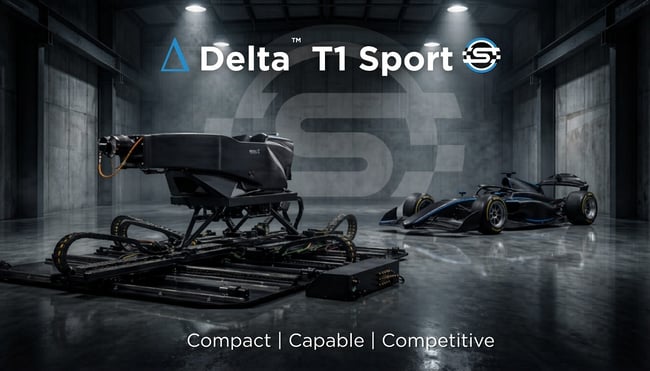
 With the launch of the Delta T1 Sport, Ansible Motion introduces the first in a new class of motorsport simulators that offers high-fidelity dynamics, ultra-low latency and a fully immersive experience – all within a compact footprint and accessible price point. Lola Cars will receive the first production unit to support its vehicle development initiatives, including its ABB FIA Formula E World Championship GEN4 campaign.
Optimised for single-seater and cockpit racing series, such as Super Formula, LMP2, LMH/LMDh, Formula E, F2, F3, F4 and Formula Regional categories, the Delta T1 Sport opens the door to engineering-class DIL capability for race teams, drivers and organisations where space, infrastructure, installation complexities and cost of ownership have traditionally been barriers.
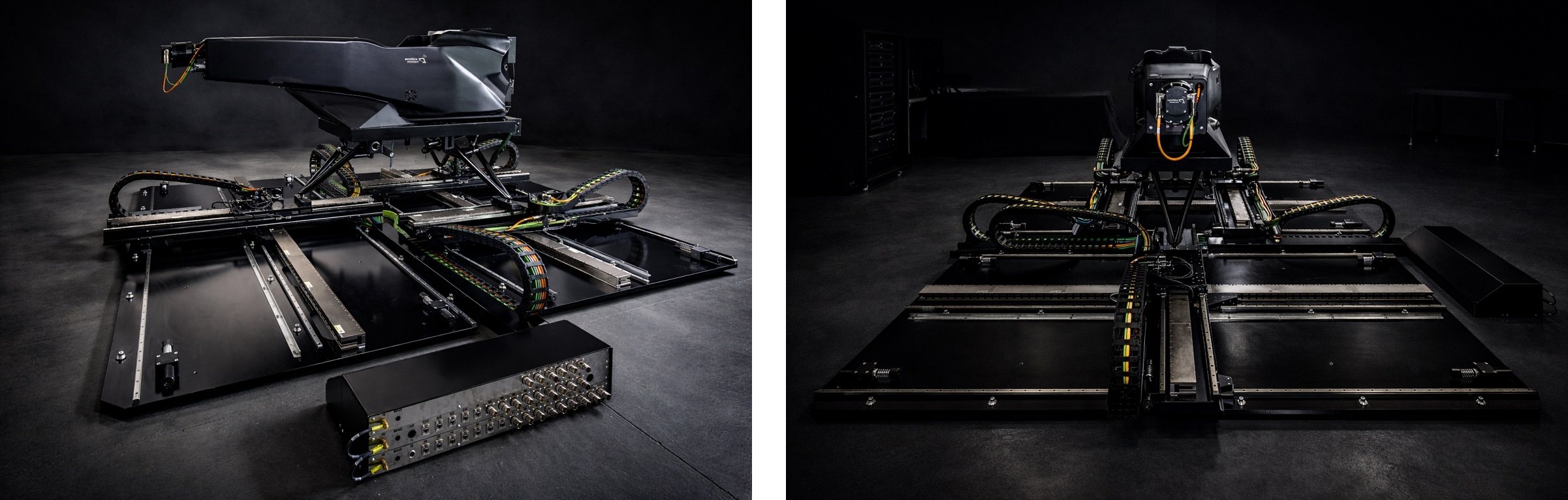
The Delta T1 Sport features an all-new Triform motion system that blends a uniquely high mechanical stiffness and low dynamic mass, to deliver elite physics, along with trusted, repeatable, tuneable motion performance.
According to Dan Clark, Ansible Motion’s managing director:
Delta T1 Sport delivers the fidelity that drivers and engineers crave in a compact, easy to install and operate, inclusive package that has not been available until now. This new class of simulator will unlock fresh opportunities for teams to efficiently pursue and extract vehicle performance gains by leveraging a streamlined, optimised approach. Our customers will benefit from best-in-class, combined solutions in terms of technical integration, technical support and value, with the freedom to distinctively configure aspects of their DIL simulation environment that ultimately lead to competitive advantages.
Delta T1 Sport in Formula E
The first production Delta T1 Sport will be delivered to Lola Cars’ Silverstone headquarters. Founded in 1958, Lola Cars is the most successful manufacturer of customer race cars of all time and has more than 500 championship wins globally. Reborn in 2022, Lola has re-established itself as a leader in design and engineering. The British motorsport company will draw on the benefits of virtual development for its Formula E programme, with a wider range of DIL-simulator-supported initiatives set to follow in the longer term.
Till Bechtolsheimer, chairman of Lola Cars, says:
We are delighted that Lola will be the first user of the pioneering Delta T1 Sport simulator which will efficiently connect to our existing workflows, enabling us to accelerate our engineering processes and improve development as we strive to drive innovation through motorsport. Ansible Motion is an ideal partner for Lola with a shared ambition to push boundaries and shape future technologies.
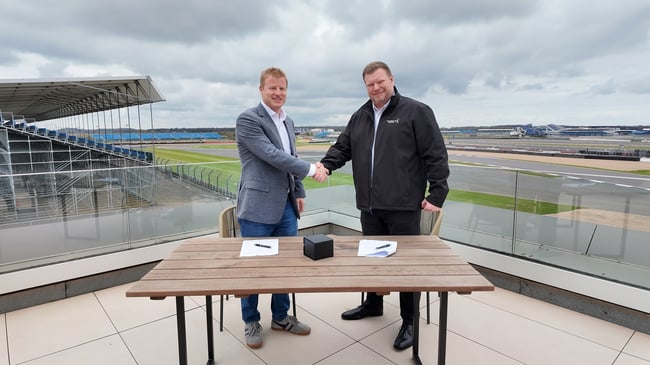 Till Bechtolsheimer (Lola Cars) and Dan Clark (Ansible Motion), signing partnership agreement at Silverstone
Peter McCool, technical director of Lola Cars, says:
We do not underestimate the impact this technology will have on our car development, software validation and race preparation, for both Formula E and future projects. As part of our relationship with Ansible Motion, we will also be able to offer this technology to our customers and clients, giving them the opportunity to experience first-hand the benefits of Driver-in-the-Loop simulation.
Clark adds,
This is just the beginning of Ansible Motion’s collaboration with Lola, which will go on to leverage emerging technologies at the cutting edge of motorsport and engineering services.
Scalable architecture to suit every application
As the latest addition to our DIL Sport simulator portfolio, Delta T1 Sport follows its Theta Seat Sport (already trusted in Formula E), and Theta Cube Sport (utilised by a European motorsport customer).

^ Click to learn more about DIL Sport simulators
Our DIL Sport range offers specialised features and capabilities that are catered to motorsport engineering – such as high dynamic fidelity, ultra-low latency, numerous driver-oriented realism elements and seamless connectivity to racing software and hardware systems.
Elliot Dason-Barber, Ansible Motion’s technical director, elaborates in the context of Delta T1 Sport:
Within six-degrees-of-freedom motion space, DIL simulators must, first and foremost, deliver sufficient ground plane fidelity – especially for vehicle dynamics and motorsport applications, where vehicle directional control and stability dominate the virtual test-driving experience. Many simulators miss this fundamental point, by starting with legacy hexapods and then working backwards to sort out additional motion requirements with appendages that add complexity and cost. Our Stratiform motion architecture has always excelled in this area, with a first-principles, pure alignment with vehicle dynamics simulation and command authority. Our goal for the Delta T1 Sport was to keep this first-principles philosophy, while reimagining motion envelopes from the perspective of a high-stiffness, agile form factor that preserves low-latency, linear command-oriented dynamic fidelity across all motion axes, while also minimising the simulator’s physical footprint and reducing physical complexity.
All-new, compact, six-degrees-of freedom motion system
Forming the heart of the Delta T1 Sport, is our all-new, patented Triform motion system (AML TMS1TM). Featuring next-level kinematics and motion generation designed specifically for motorsport and high-performance applications, Triform preserves the spirit of large-scale Stratiform dynamics, while also distilling the physical footprint down to a practical minimum.
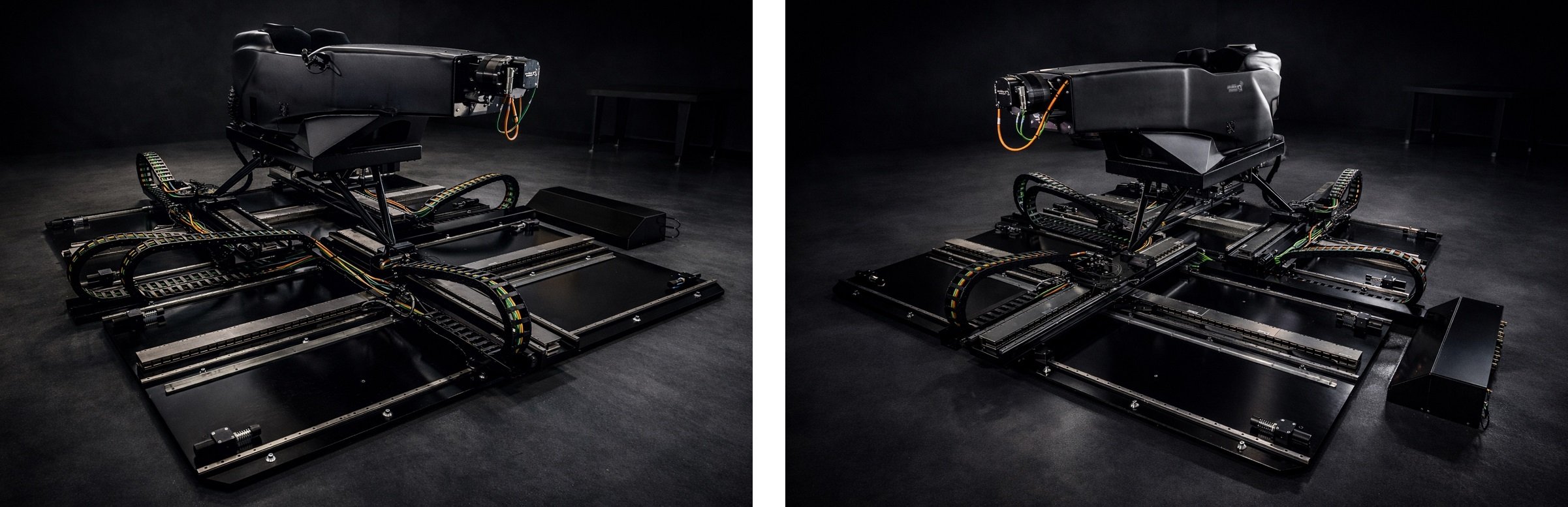
With a payload capacity of up to 300kg that accommodates drivers along with feature-rich racing cockpits, the Delta T1 Sport offers a full six-degrees-of-freedom motion envelope, including 1m of surge, 1.2m of sway and 120˚ of yaw. Heave, roll and pitch capabilities are 0.2m, 22˚ and 16˚, respectively. We've optimised this motion envelope based on our 17 years of experience creating dynamic DIL simulators, to be the physical packaging minimum to deliver realistic virtual testing experiences to drivers and engineers who demand to be accurately informed by nuanced perception of vehicle limit handling balance, track irregularities, yaw stability and vertical dynamics. Delta T1 Sport simulators also include our highly-configurable motion cueing package to tailor sensory feedback to specific series, driver personas and vehicle tuning strategies.
This overall motion space is efficiently packaged within a low mass, 2.4 x 2.4 m floor footprint, making the Delta T1 Sport an extremely compact, high-dynamics DIL simulator – which enables flexibility of location and operation without special facility or flooring requirements, while providing a significant reduction in cost of installation and ownership compared to larger dynamic DIL simulators.
Connected experience
Increasingly, DIL simulation forms part of wider ecosystems for race car development work, and Delta T1 Sport is designed with this in mind. Delta T1 Sport can be networked in multi-sim environments, and it includes our established DIL toolchain and software framework that provide seamless connectivity to external Software-in-the-Loop (SIL) and Hardware-in-the-Loop (HIL) environments.
Together with our sister company, rFpro, the industry-leader in real-time visualisation software, high-speed rendering, track surface modelling and virtual race circuit libraries, we offer complete end-to-end motorsport simulation packages that cover the cornerstones of productive DIL simulation – motion and vision. In addition, our long-standing partnerships with motorsport-focused companies such as AVL RACETECH, enable seamless connectivity to trusted vehicle modelling and analysis toolsets, as well as external systems.
Salman Safdar, Ansible Motion’s business development director, says:
The Delta T1 Sport also includes a number of bespoke driver feedback and immersion systems to suit physical space, budget and performance requirements, as well as future-proofing and upgrade pathways – including, but not limited to, multiple space-efficient vision systems – including projectors, LED wall, extended reality (XR) and virtual reality (VR) options; configurable race car cockpits; active dashboard and steering wheel interaction capabilities; adjustable racing seats; configurable pedals; haptic and torque feedback for steering; harness and helmet loading systems.
With full dynamics, a uniquely compact design, seamless connectivity to racing toolsets and an attractive price point, the Delta T1 Sport is poised to redefine and expand DIL simulator usage across a wider field of racing series than ever before.
Read more about Delta T1 Sport and Lola's initiatives on the Racer website.