 The 2026 IndyCar Series calendar added three brand-new temporary street circuits—routes where race cars had never driven before, meaning there was no historical data, onboard footage, or rubber deposits to reference.
The tight schedule forces teams to settle in to the tracks’ unique rhythms with precision the moment that cars are unloaded from the transporters. The challenge becomes: how does a team prepare for a venue it’s never visited?
Honda Racing Corporation (HRC)’s solution is to rely upon Driver-in-the-Loop (DIL) simulation.
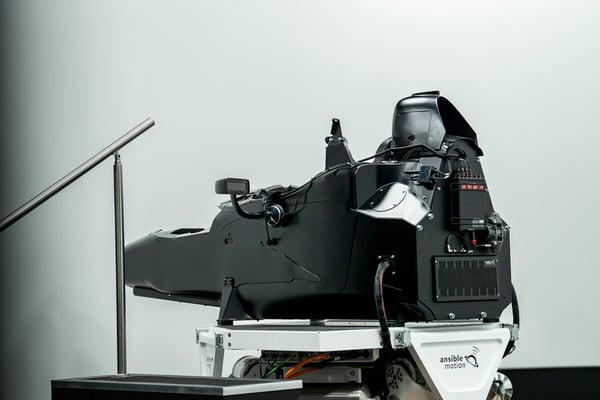
Far from being a modified high-end gaming setup, HRC’s IndyCar DIL simulator is an ultra-realistic virtual laboratory designed to achieve seamless alignment between virtual testing and real-world racing. HRC’s simulator in Indianapolis—an Ansible Motion Delta S3 DIL simulator—integrates an actual IndyCar cockpit and features advanced motion, computation and graphics rendering that integrates with Honda’s precision-modelled aerodynamic data, laser-scanned track layouts, and proprietary tire models developed in-house by HRC.
To ensure the simulation mirrors reality as closely as possible, team engineers employ high-fidelity, millimeter-precision LiDAR scanning technology and graphics generation capability powered by our sister company, rFpro. This process digitally captures every detail—including track surfaces, curbs, barriers, drainage channels, undulations, and banking—and converts these intricacies into precise surface models that can be executed in real time on the DIL simulator, both computationally and visually.
DIL Simulation and the Human Element
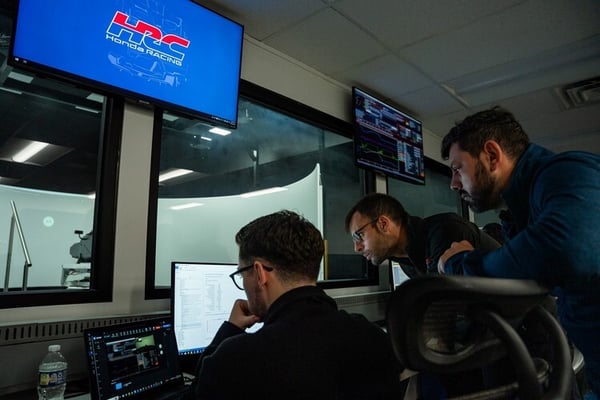
A DIL simulator’s sophisticated hardware and software setup also invites human input “into the loop” to fine-tune its development and utility. For this, HRC recruited Linus Lundqvist—the 2024 IndyCar Rookie of the Year—to serve as the development driver for its IndyCar DIL simulator. Lundqvist is tasked with driving thousands of laps on virtual tracks, helping HRC calibrate simulation parameters and further enhance the DIL simulator’s predictive capabilities.
Everything from data acquisition and filtering of track data to the processing of fine-tuning details influences how closely the simulation matches reality. And the challenge increases exponentially for entirely new venues.
The process begins the moment IndyCar confirms a new track, which typically involves collaborations with experienced track designers. HRC first obtains the basic engineering drawings defining the circuit, pit lane, start/finish lines, and safety runoff areas. The layout is then provided to the rFpro team, which scans the street circuit and returns a usable Digital Circuit Model (DCM). This is no small undertaking: transforming raw scan data into a drivable track for a DIL simulator requires mathematical rigor and artistic prowess. All this work must be completed approximately eight weeks before a race event.
Even with tracks fully digitized and vehicle models at the ready, many unknowns remain. For example, grip levels on temporary street circuits are inherently volatile. Although all IndyCar teams use Firestone tires, the specific strategies for optimizing the nuanced interactions between rubber and asphalt along the length of a circuit—on which the cars have never driven!—are closely guarded secrets that vary from team to team. This technical disparity (and others) define certain predictive performance gaps: some teams arrive with near-perfect car setups, while others start on the back foot. Inaccurate predictions are inevitable, but the team that gets it closest to right gains a decided advantage.
Honda’s Recipe for Success
HRC’s engineering team works behind the scenes months in advance, while the race team and drivers begin the final, intensive phase of preparation roughly two weeks before any given event. Even before the final track models are fully developed, HRC utilizes offline simulations to help address fundamental questions—such as gross aero tuning settings and gear ratio selections. Once everything is as ready as it can be, DIL can “go live,” and the simulator lab becomes the busiest area at HRC’s facility; drivers engage in intensive simulator sessions, aiming to train as close to the race weekend as possible to hone and maintain their muscle memory.
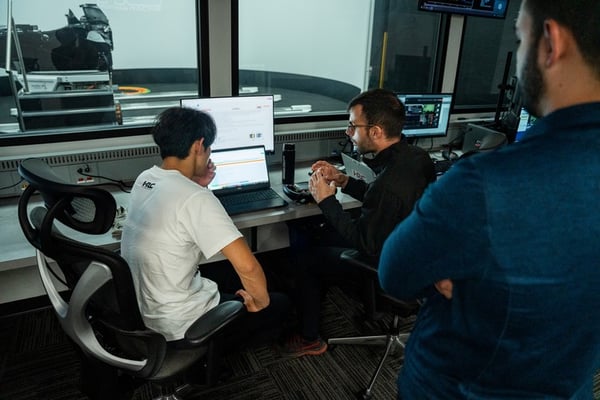
HRC’s DIL-supported preparations have proven successful thus far in 2026—Honda has achieved wins in 17 of the last 19 street circuit events, including never-raced-on-before tracks. HRC attributes this dominance to meticulous pre-race preparation that is supported by simulation tools, thorough data collection and analysis, and the fundamental ability to conduct Driver-in-the-Loop evaluations of the track and the car in advance of competitions.
One example is Kyle Kirkwood’s recent win at IndyCar’s Freedom 250 Grand Prix of Washington DC, which took place on August 23. Kirkwood has commented that HRC’s DIL simulator is “the best simulator I’ve ever used” and finds it to be an invaluable tool for race day preparations.
During preparations for the Washington DC race, Honda Racing US posted a glimpse of one of its simulator preparation sessions on its YouTube channel. It doesn’t reveal any team secrets, of course, but it offers some interesting DIL simulator action footage and commentary:
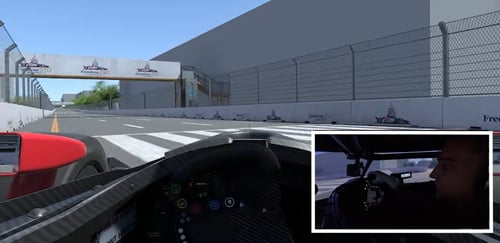
Temporary street circuits are becoming increasingly popular in IndyCar and other series, as organizers have come to realise that these lower-cost venues can generate significant business opportunities for both race series and the local communities. For fans, street races offer a more immersive experience than traditional purpose-built tracks; however, for drivers, sprinting at full speed through "concrete canyons" leaves virtually no margin for error—deviating by just a few centimeters can result in disaster.
Ansible Motion is honoured to be a contributor to the DIL simulation workflows that helps teams stay safe while boosting competitiveness as they pursue excellence on track and off.
Read the full article on the Auto Online website.