 AI is changing the arithmetic of what F1 team allowances can buy as teams face an increasingly capped rulebook. Take a deep dive into F1’s newest battlefront.
Formula 1 teams have faced restrictions on off-track development for several years. These limitations set a sliding scale for wind tunnel usage and computational fluid dynamics (CFD) evaluations based on the previous season's constructors' championship standings, so the team that finished last receives the largest allowance, teams further up receive progressively less, and the champion has the least. Allowances are distributed through the year rather than as one lump sum, so teams must decide both what to develop and when.
F1 teams are data rich, of course, with hundreds of sensors per car and more from every test and simulation. What is limited is the ability to generate new, reliable answers. A team can analyse existing data indefinitely, but to assess a genuinely new part it must draw from its allowance.
Compounding this are the 2026 regulations, introducing a new chassis, modified vehicle dynamics, revised aerodynamics with a movable front wing, and greater emphasis on the electrified powertrain as the internal combustion engine gives up output. Each change makes previous knowledge about extracting performance less applicable, devaluing understanding accumulated over past seasons.
A subset of artificial intelligence (AI) called physics AI can now assist under these constraints. Yeshwant Mummaneni, Senior Vice President of AI, HPC, MDAO, and SaaS at Siemens Digital Industries Software, explains:
Elastic, on-demand computing has been common for years. What makes physics AI different is its ability to calculate and validate results using only a small fraction of the testing allowance compared to other HPC simulation methods, and to do so at a speed that lets teams explore track-specific changes or general improvements long before they reach their limitations.
Ilya Tolchinsky, Principal Product Manager of AI at Synopsys, whose clients include Formula 1 teams, adds:
The aim of these restrictions is to limit the number of CFD simulations and assessments of changes to the car's geometry. With physics AI, our proposition is that we can evaluate thousands more designs within the same computational budget.
Understanding physics AI models
Imagine determining the depth of a lake. Lowering a weighted line at every point would give an exact answer and take a lifetime. Instead, you take a few hundred soundings spread across the lake, draw contours between them, and read the depth at any location off the chart. The result is a model built from a limited set of real measurements, accurate enough for decisions within the surveyed area. This is a surrogate model, the foundation of most physics AI. A team runs a limited number of expensive, trusted simulations on a conventional solver, trains a machine learning model on the results, then queries the model instead of the solver.
Beyond the surveyed area of the lake, the contours become estimates rather than inferred measurements, which is the central consideration for any engineer using a surrogate. Tolchinsky emphasizes:
If you venture too far outside that dataset, extrapolation becomes impossible, requiring additional simulations to expand the training dataset and keep you within appropriate limits.
When the car changes, that training data must be regenerated, though Tolchinsky notes this does not diminish capability. Rather than the thousands of runs needed to cover every variation of every circuit, a few hundred initial simulations are enough to build surrogates that carry the remaining analysis, so a small number of trusted evaluations buys thousands of cheaper ones. That is an effective exchange where the regulator limits how many trusted evaluations are allowed.
The driver closes the loop
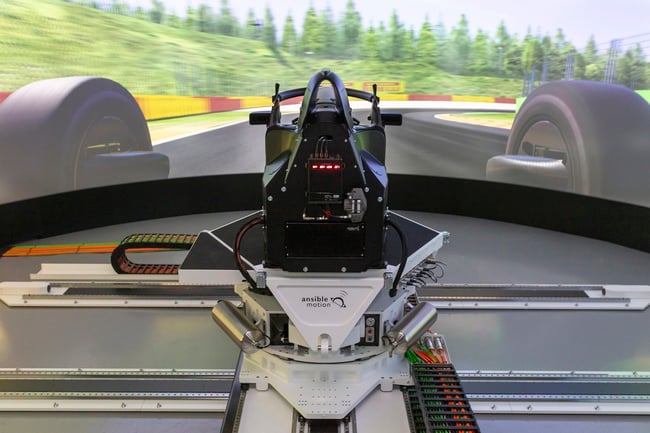
All of these models – and more – must eventually meet a human operator, which happens in a Driver-in-the-Loop (DIL) simulator. Salman Safdar, Ansible Motion’s subject-matter expert in DIL technology, stresses that its value lies in assembling multiple models rather than adding hours to a development timeline:
A DIL simulator is often the first point in the chain where all the various models come together for the first time, often before any physical hardware exists.
The architecture must run numerous models from different sources synchronously while merging that computation with the motion, vision and cockpit systems that create the driver's experience, which Safdar likens to an orchestra combining strings, woodwinds, brass and percussion into a single composition.
Asked whether machine-learned models are harder to trust in that setting, Safdar states:
The source of the models feeding the DIL simulator, whether AI-generated or otherwise, is not usually a concern. A good model is a good model, regardless of how it was created. A source-unknown, black box engine model will either perform correctly or it won't. If it doesn't perform, we can identify and rectify the issue.
The subtler challenge is that a DIL simulator can create the same sensation by several means, so a driver's approval does not confirm the model is accurate. A virtual vehicle that feels unusual but prompts realistic driver behaviours is often more desirable than one that feels perfect but necessitates unrealistic behaviour behind the wheel. Drivers also tend to find the limits of a model before its error metrics do, which returns the discussion to the difference between uncertainty reported as a number and uncertainty felt in the seat.
One constraint governs all of this integration, which is that everything must run in real time. A thermo-mechanical tyre model that takes three minutes to compute parameters for a 1.5-minute lap may be useful for offline work, but it's completely unusable with a driver in the seat. A modelling expert must make simplification decisions that impact the overall performance of the DIL simulation. Smaller models with the right data make the difference, and a DIL simulator becomes more powerful as its modelling data improves.
Linking a dynamic DIL simulator to a bank of static AI simulators can extend testing to race strategy, letting drivers, engineers and strategists share one simulated event and rehearse energy management, aerodynamic interactions and traffic before arriving at a racetrack. Safdar concludes:
A simulation might indeed be able to create 'the perfect car.' But perfect for whom? Without a driver, a car is not complete; it’s a plant lacking a primary control system.
The full article is available in the September 2026 issue of Professional Motorsport World magazine, available on newsstands now and also viewable online.