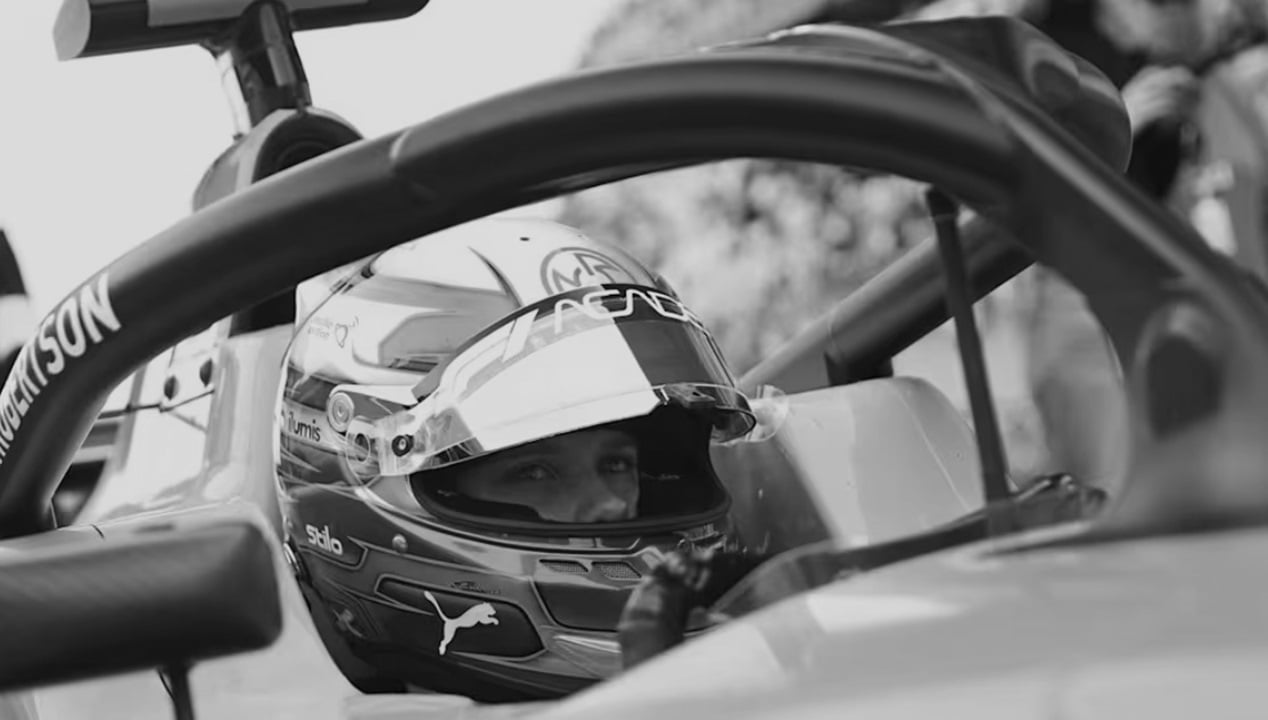
F1 Academy racer Rachel Robertson has been using an Ansible Motion DIL simulator to build the consistency, focus and repeatability needed ahead of the British Grand Prix weekend.
As Robertson prepares for the third race in the 2026 series – her ‘home’ round at Silverstone – excitement is high. Familiar faces, a home crowd and the atmosphere of a Grand Prix weekend all add to the occasion. We spoke with her about what she perceives as the five key areas that contribute to effectively using DIL simulation for race day preparation.
1. Building consistency
Behind the glamour and hype of the GP weekend, there is real work to be done: hours spent in an Ansible Motion Delta series Driver-in-the-Loop (DIL) motorsport simulator, turning virtual laps into repeatable performance.
For Robertson, halfway through her first full season of F1 Academy, simulator work is not simply about chasing a single fast lap. For her, the greatest value lies in consistency. She explains:
The main way I use it is for learning, repeating and building consistency. Something that I have sometimes struggled with in the past is putting together a few fast laps but not necessarily being able to repeat that consistently.
2. Marginal gains
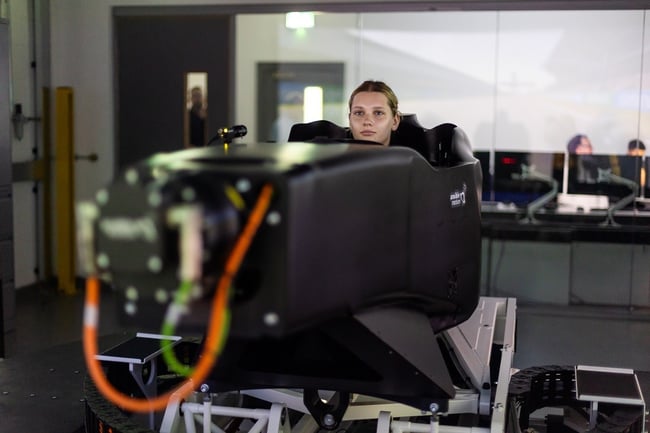
Distinction matters in a series where margins are narrow and every session behind the wheel is an opportunity to learn and improve. In a spec championship, performance gains often come from how a driver works with their car, the engineers and their own mental process. Robertson describes the simulator as a place where she can practice not only qualifying laps and race runs, but also defensive lines and long periods of focused repetition:
It is super valuable to spend time in a sim, especially with the race team alongside me. They know the cars really well, and they have reference laps from other drivers who have moved up in the series.
For Robertson, the ability to run dozens of laps, receive guidance and then immediately apply that feedback makes simulation a powerful tool for finding marginal gains.
3. Eat, sleep, race, repeat
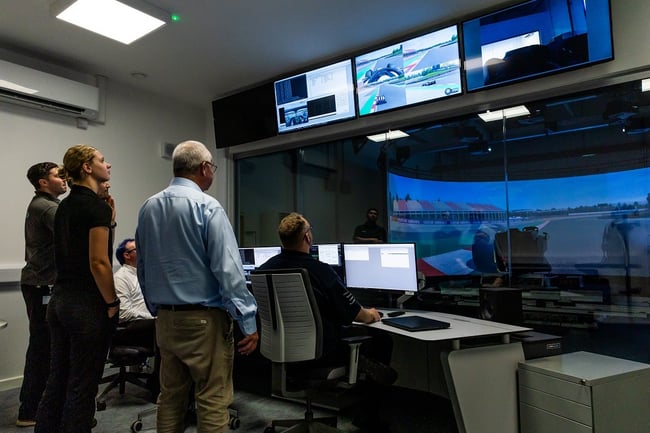
This is where the simulator environment becomes particularly relevant. Ansible Motion’s high-fidelity DIL simulation tools place real drivers in virtual settings and situations, enabling engineers and drivers to evaluate vehicle behaviour in a controlled, repeatable environment. In motorsport applications, the combination of driver immersion, engineering feedback and repeatability is especially valuable.
Robertson says the immersion of the Ansible Motion setup is what makes the experience stand apart. Rather than a chair, pedals and a screen, the simulator cuts out distractions and gives her the opportunity to become fully absorbed in the task at hand. She points to the cockpit environment (“the tub”), harnesses which tighten under braking, brake feel, accurate steering weight and motion cues as details that help her switch into a more purposeful driving mindset.
Fully scanned track models from our sister company, rFpro, and low latency dynamic performance are also key to the experience, with every corner, kerb and elevation change faithfully recreated in the virtual world to immerse the driver and help Robertson build familiarity. She describes it this way:
You know you’re not at a track, but the whole setup that Ansible Motion has really gives you the best opportunity to almost forget that you’re driving a simulator. It’s that immersion which is super helpful to get into the zone.
4. Understanding the limitations of simulation
Robertson is clear that simulation is not a replacement for the real thing. Track temperatures, weather and grip levels can all vary once a driver reaches the circuit. At Silverstone this year, F1 Academy free practice is early on Friday morning and qualifying is later that evening. There is a reverse-grid race on Saturday, then the main race is on Sunday morning. Conditions are therefore likely to vary dramatically from one session to the next. The final race of the season is Las Vegas, where Robertson raced as a substitute driver last season. According to Robertson:
You're racing down the Strip and the roads during the day are actually all open. Any rubber that gets laid down just gets completely washed away by all the traffic, and it can get really dusty, which is super hard to recreate accurately in a simulation.
5. Acclimatisation
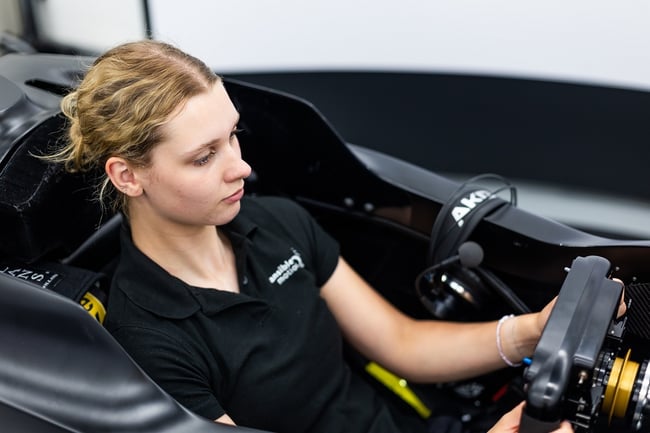
Even so, the simulator gives her a solid foundation. “It gives you that base to build upon,” she says. As she approaches any race, simulator work helps establish reference points, braking markers, track knowledge and a clearer picture of what to expect.
Drivers only have limited track time with each race weekend: two 40-minute free practice sessions, one qualifying session of 30 minutes, and two or three races of up to 30 minutes. It’s intense, and leaves little time for reflection.
In the run up to Silverstone this week, simulation becomes all the more valuable in preparing and acclimatising for a race weekend. And it will be no different as Robertson approaches the remaining races in the 2026 season (Zandvoort in August, Austin in October, or Las Vegas in November).
For Ansible Motion, that is the value of DIL simulation in a motorsport context. It gives drivers and engineers a controlled, repeatable environment in which to explore variables, build familiarity, better understand vehicle dynamics and limits and practice lap-after-lap consistency; all before the pressure of a race weekend begins.
As Robertson looks ahead to Silverstone this weekend and beyond, simulation is helping her to arrive better prepared than ever: more consistent, more focused and looking forward to turning simulator learning into on-track performance.
Rachel Robertson is a brand ambassador for Ansible Motion.
Learn more about Ansible Motion’s DIL Sport simulators here: