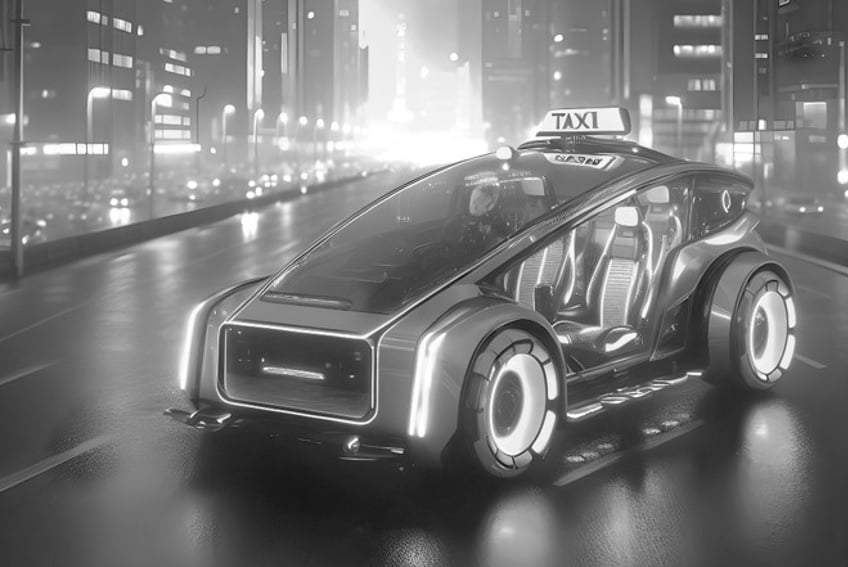
As robotaxis and autonomous vehicles become increasingly sophisticated, rolling out into more cities worldwide, Driver-in-the-Loop (DIL) simulation may seem like an unlikely part of their development. After all, with no human driver, why employ a driving simulator? The answer lies in recognising that controlling a vehicle and experiencing a vehicle are two very different things.
Hollywood has conjured up driverless vehicles for decades. From the autonomous Johnny Cab in Total Recall to the futuristic Audi RSQ in I, Robot, the idea of simply telling an automated vehicle where to go has long been part of our collective imagination about the future.
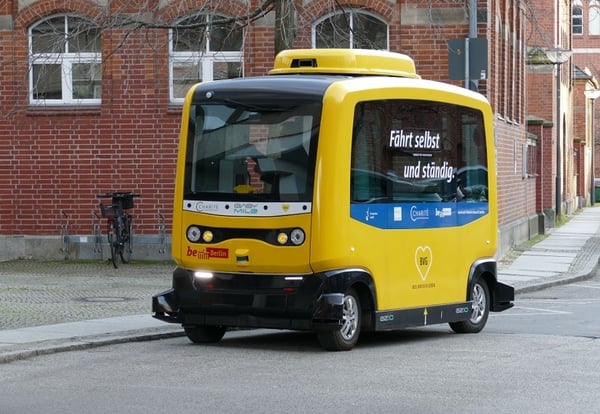
Today, that future is beginning to arrive. Autonomous taxi services – robotaxis – are moving beyond technology demonstrations to become viable transport options in several cities across the US and China. Other major cities, including London and several European capitals, are now considering how these services might fit into their own transport networks.
But while much of the attention is focused on artificial intelligence (AI) and the sensors and control systems that make autonomous driving possible, there is an important question deserves consideration: what is the role of DIL simulation in a vehicle’s development if nobody is actually driving the vehicle?
The answer may seem obvious at first glance. There isn’t a role because a driving simulator, by default, needs a driver.
But is this true?
The human element remains important
Historically, driving simulators have connected real people with virtual vehicles and environments. The person in a DIL simulator controls the virtual vehicle with steering, throttle and braking inputs; the virtual vehicle responds, feedback returns to the driver, and the cycle continues.
Our previous article, Driver-in-the-Loop Simulators: Who's the Driver?, explained that the human driver in a traditional DIL simulator effectively serves as the ‘control system’, while the vehicle is the ‘plant’, the system being controlled. The driver is quite literally in the loop.
The proliferation of Advanced Driver Assistance Systems (ADAS) has complicated this relationship. On-board systems such as lane keeping assist (LKA), adaptive cruise control (ACC) and automated emergency braking (AEB) introduce additional controls which operate alongside the human driver.
But humans remain an essential part of the driving experience. Indeed, as ADAS technologies have become more capable, understanding how their interventions affect drivers’ experiences has become increasingly important.
Is a lane-keeping system reassuring or intrusive? Does an adaptive cruise control system behave naturally? Are warnings and interventions delivered at the right time? Does the driver feel confident in what the vehicle is doing?
These are questions that cannot be answered through calculations and off-line simulations alone. They require human participation and assessment.
Autonomous vehicles take this relationship a step further. AI systems control the vehicle's trajectory, while the human occupant may have little or no influence over where or how it travels.
But the occupants haven’t disappeared from the equation. They still experience acceleration, braking, cornering, ride comfort, noise, vibration and the vehicle's responses to traffic and pedestrians. They still form opinions about whether the journey feels comfortable, predictable, reassuring and safe.
In other words, although humans may no longer be in a vehicle's control loop, they remain very much in its experience and evaluation loop.
‘Driverless’ doesn't mean ‘human-free’. If anything, the passenger experience matters even more.
A different kind of Driver-in-the-Loop
This distinction is important because it changes how we might think about DIL simulation.
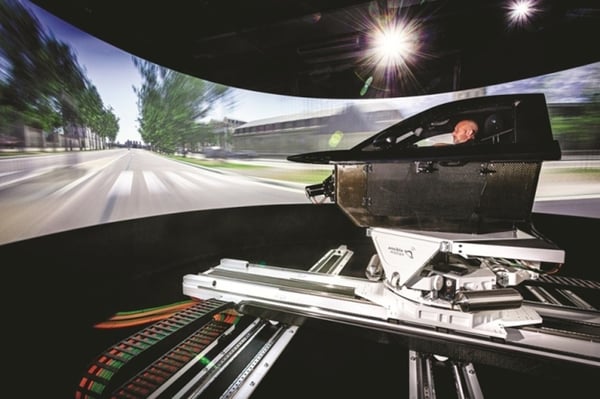
In traditional vehicle developments, a person in a DIL simulator drives and evaluates a virtual vehicle. With autonomous vehicles, AI may do the driving, but a real person remains present as an occupant, observer and evaluator.
A DIL simulator therefore becomes more than a virtual driving environment: it becomes a means of evaluating the interactions between autonomous vehicles and their passengers.
Consider a few examples.
How does a robotaxi behave when approaching a busy pedestrian crossing? Does it brake smoothly and predictably, or intervene abruptly? When another vehicle cuts in front, does its response feel controlled and reassuring to occupants? When it encounters roadworks, an unexpected obstruction or an unusual traffic situation, does it make decisions that are technically safe but cause passenger discomfort or confusion?
More fundamentally, does the vehicle accelerate, brake and corner as people expect? Do its decisions inspire confidence, and can passengers understand what the vehicle is doing when it behaves differently from a human driver?
These development questions illustrate why human evaluation may become more important as vehicles become increasingly autonomous.
Not every autonomous vehicle simulation needs a human occupant. If a vehicle transports goods, for example, ride comfort and passenger acceptance is not relevant. But for robotaxis, autonomous shuttles and other people-carrying vehicles, the human experience remains central to development.
Robotaxis need somewhere safe to fail.
There is another important reason why DIL simulation deserves a prominent role in autonomous vehicle development: safety.
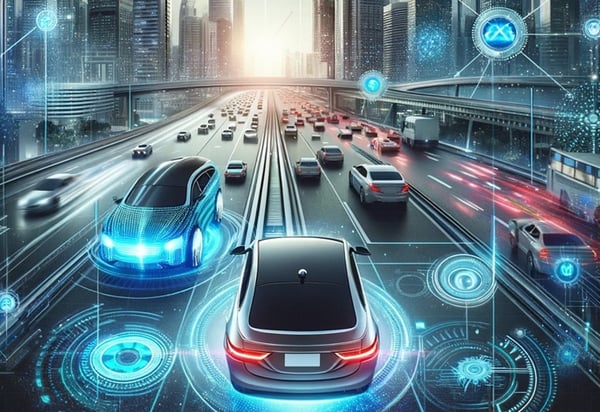
As ride-hailing companies roll out their technologies, one important engineering question is becoming harder to ignore: where should a robotaxi be allowed to fail?
Developing any intelligent system means exposing it to situations that challenge its existing knowledge and logical responses. As with human learning, AI learning is fuelled by making and addressing mistakes. The key is to avoid exposing passengers, equipment and other road users to unnecessary risk while this learning takes place.
This touches on technology mapping, engineering directives, regulatory concerns and urban planning. It’s a question which feels particularly relevant in London right now.
A recent report from the London Assembly Transport Committee, Who’s driving the future of autonomous transport in London?, published in October 2026, sounds a note of hesitation. It questions whether London should welcome autonomous passenger services without stronger evidence and local oversight, and whether proposed robotaxi deployments would actually support London’s Vision Zero goal (to eliminate all deaths and serious injuries from the city’s transport network by 2041). For now, no detailed framework exists for safety-first autonomous vehicle (AV) developments in London.
Beneath this policy debate, echoed in major cities worldwide, lies a wider engineering issue: evidence and capability gathered in one environment doesn’t automatically translate to another. A system proven in the San Francisco Bay Area or Beijing's Yizhuang district isn’t necessarily ready for London’s complex and more archaic road network. Nor does success in London guarantee success in Paris, Munich, Sydney or Tokyo, each of which is currently considering robotaxi roll-outs.
Even within the same country, local conditions create unexpected challenges. Melbourne, Australia for example, still has hook turns to accommodate tram pathways, where vehicles move out wide before turning across intersections. These manoeuvres are rare elsewhere in Australia but pose an interesting test for autonomous driving systems.
Developers rightly invest enormous effort in preventing AVs from failing in the wild, but the real world can produce almost limitless combinations of road layouts, traffic conventions, weather conditions, road users and human behaviours. Some situations that developers would prefer never to encounter on public roads still do occur: sudden obstacles, animal crossings, erratic road users, unexpected detours, extreme weather and system failures.
These edge cases can expose weaknesses in any autonomous system's decision-making. Real-world testing is essential, but public roads aren’t always the best place to discover how safety-critical systems respond when things go wrong.
This is where DIL simulation becomes particularly valuable.
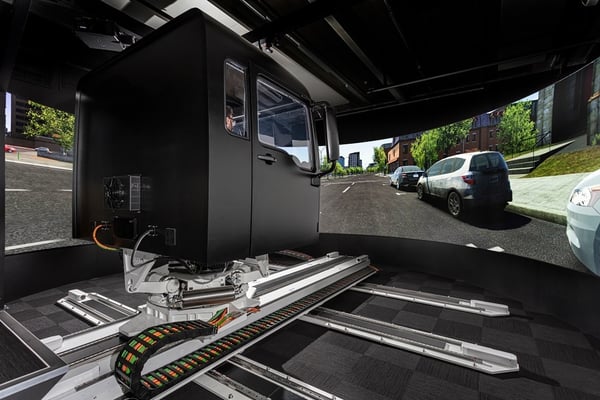
DIL simulation complements real-word testing
DIL simulation labs are established, trusted virtual development environments that allow engineers to repeatedly expose autonomous driving systems to challenging situations without putting physical vehicles, occupants or other road users at risk. By revisiting individual scenarios with varying conditions, AV developers can examine not just whether systems will ‘succeed’, but also assess how vehicles respond when circumstances change – even beyond expected operating conditions. If a system falls short, it’s the perfect environment to improve it.
Individual scenarios can be run with different combinations of speed, weather, traffic density, road layouts and road user behaviour. Vehicle engineers can then investigate not only whether an autonomous system performs as expected, but also how it responds, from a human-centric perspective, in situations beyond its expected operating conditions.
This creates an opportunity to examine two complementary aspects of autonomous vehicle performance: whether an AI system is behaving appropriately, and whether the resulting experience is acceptable to passengers.
Simulation shouldn’t replace real-world validation, as AVs must ultimately prove themselves on real roads. But there’s a strong case to be made, whether by organisations such as the London Assembly or by road users, that public roads should be the final test for robotaxis, and not the classroom for initial learning about how safety-critical systems respond when things go wrong.
This means that real-world mileage accumulation alone cannot provide the complete answer. AV developers need to deliberately seek out and investigate the difficult situations and edge cases that ordinary running mileage may never reliably reproduce. This entails varying conditions, repeating events and exploring the boundaries of a system’s performance in a controlled DIL simulation lab environment.
AVs need to operate in the real world, but their developers need to consider whether every lesson should be learned there. If robotaxis are to become an accepted part of everyday traffic, giving them somewhere safe to fail could be one of the most important steps towards making them safe enough to succeed.
The future of DIL simulation
The arrival of driverless vehicles does not make Driver-in-the-Loop simulation obsolete. If anything, it gives the technology another important role to play.
The term 'driver' has traditionally meant the person controlling the vehicle, but the wider purpose of DIL simulation has always been to connect real people with virtual vehicles and driving environments. As vehicle automation increases, the human’s role evolves: from driver, to driver assisted by ADAS technologies, to passenger in a vehicle controlled entirely by AI systems.
Throughout that progression, human experience and acceptance remain important in developing vehicles designed to transport people. At the same time, AV developers need a safe space to explore unusual situations, failures and edge cases that ordinary real-world mileage may never reliably reproduce.
Combining autonomous driving systems with human participation in a controlled DIL simulation environment addresses both requirements.
So, perhaps the question isn't whether driverless vehicle development still requires DIL simulators. Instead, it’s whether we should view DIL simulation as more than a way of placing a human driver into the driver’s seat.
After all, even when the vehicle does all the driving, there's still a human being along for the ride.
Ansible Motion’s DIL simulators are deployed worldwide for automotive development workflows, including the specific challenges faced by vehicle manufacturers developing AV and AI systems. To learn more about our unique approaches and technologies, download our FREE eBook, Beyond the driver: Designing tomorrow's ADAS and CAV vehicles.